
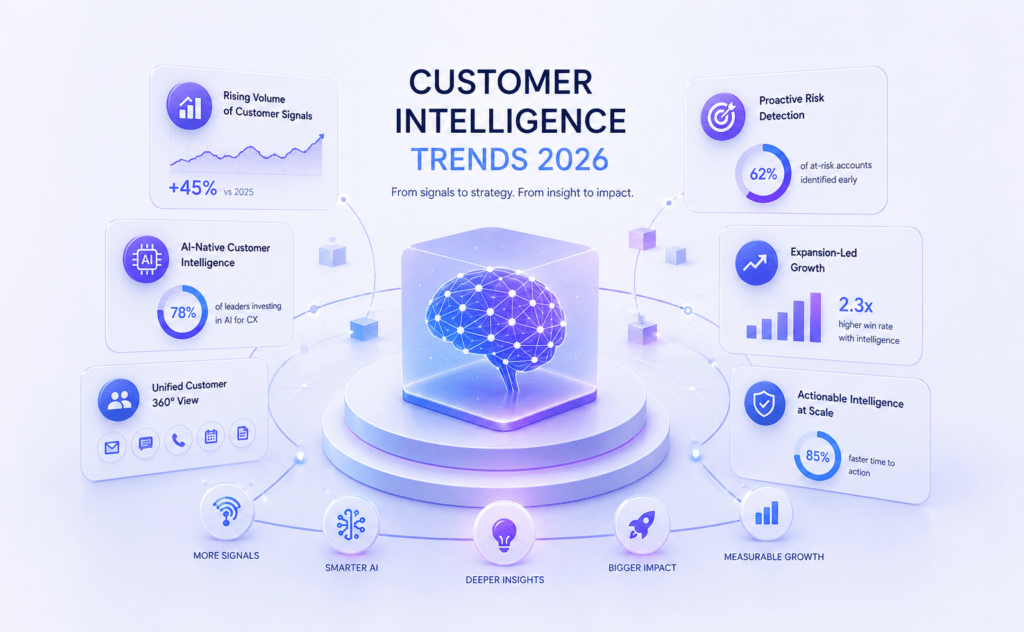
Customer Intelligence Trends 2026: For B2B Leaders
Updated April 21, 2026 | 8-minute read | By Revenue Intelligence Team
Customer Intelligence Trends 2026: For B2B Leaders represent a fundamental shift from passive data aggregation to proactive signal detection and control systems. This evolution is driven by the need to combat high B2B churn rates (averaging 3.5% monthly) and a troubling paradox: more data hasn’t led to better predictability. According to the Zendesk Customer Experience Trends Report 2026, 70 percent of organizations are now actively investing in tools that capture and analyze customer intent signals, making it critical for businesses to strengthen their data analysis capabilities to stay competitive.
Revenue teams face a critical tension: more tools and data volume have not translated to better control over customer outcomes. B2B revenue teams lose deals when they cannot see what buyers actually think. When engagement data lives in silos, communication history sits scattered across systems, and insights arrive too late, reps end up reacting to problems instead of preventing them. Customer intelligence platform trends in 2026 are being shaped by this shift from insight generation to proactive control systems that enable early intervention.
“The winners in 2026 will not be the companies with the most data, but those that can detect signals early and act before outcomes change.” — Customer Portfolio Intelligence Research
The Evolution From Data Aggregation to Signal Detection
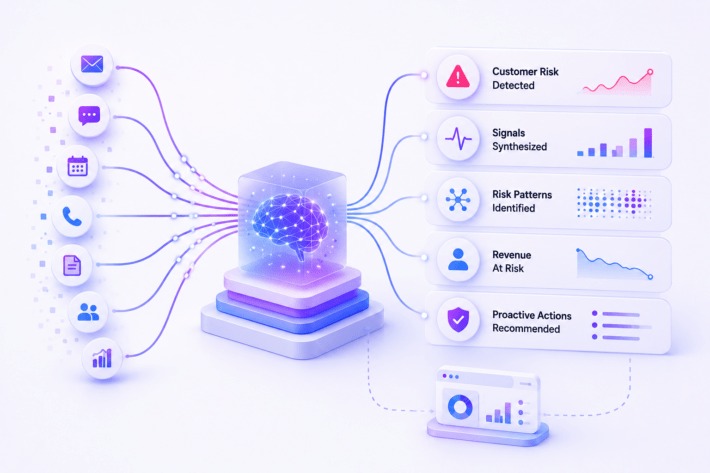
Traditional customer intelligence platforms focused on collecting and organizing customer data across touchpoints. Today’s B2B leaders need something different: platforms that move beyond reporting to identify early warning signals that predict customer behavior changes. Here’s what matters most: your B2B support team’s data holds a wealth of intel that can help you predict and prevent churn. Building a system that detects those signals and enables intervention while there’s still time to change the outcome has become a best practice among modern B2B support teams.
- Signal identification: Modern platforms prioritize detecting early indicators of churn, expansion, or stakeholder changes rather than simply aggregating historical data.
- Predictive timing: Most predictive sentiment models can identify churn risk 2 to 4 weeks before cancellation, depending on interaction volume and data quality. This extends intervention windows significantly.
- Behavioral pattern recognition: Behavioral signals (purchase decline, login drop) typically lag emotional signals (tonal flattening, engagement withdrawal) by 1–2 weeks. A customer decides to leave emotionally before they act on it transactionally.
- Communication pattern analysis: A 2024 study published in the Journal of Service Research found that “communication cessation” is a stronger predictor of customer defection than complaint frequency, across both B2B and B2C contexts. The research analyzed over 840,000 customer interactions and concluded that silence — not anger — is the most reliable churn signal.
Signal Detection vs. Traditional Analytics
| Traditional Approach | Signal Detection Model | Business Impact |
|---|---|---|
| Monthly health score reviews | Continuous signal monitoring | 60-90 day advance warning |
| Reactive intervention | Proactive engagement | 25-40% churn reduction |
| Lagging indicators | Leading indicators | Extended intervention window |
| Account-by-account analysis | Portfolio-wide scanning | 100% coverage vs partial |
Key Takeaway: The most important shift in customer intelligence platform trends 2026 is the move from data collection to early signal detection, giving revenue teams 2-4 weeks additional time to prevent negative outcomes. For deeper context, see CX Today’s analysis of customer analytics and intelligence trends. This capability advantage becomes even more critical when managing large customer portfolios at scale.
Portfolio-First Architecture Replaces Account-Centric Design
Portfolio-first architecture represents a fundamental shift in how revenue teams manage customer relationships. Instead of analyzing accounts one by one—a process that doesn’t scale—these platforms provide portfolio-wide visibility with automated prioritization. Revenue teams can no longer manage customer portfolios individually at scale. AI churn prediction flips this by identifying at-risk accounts 60-90 days before cancellation, giving your team time to intervene when it actually matters.
- Automated scanning: Platforms continuously monitor entire customer portfolios rather than requiring manual account reviews.
- Risk-based prioritization: Tiers of risk are automatically assigned to guide action. For example, a Tier 1 high-risk account (over 70% churn probability) triggers a CSM outreach within 48 hours. This is not a generic check-in, but a specific conversation addressing detected risk factors, such as: “We noticed your team’s usage of the reporting module dropped significantly. Can we schedule a session to make sure it’s working for your workflow?”
- Portfolio health metrics: Revenue leaders need aggregate views of portfolio health trends beyond individual account status.
- Capacity optimization: CSM teams require automated workflows to manage larger account portfolios effectively without a proportional increase in headcount.
Account Coverage Models
The shift to portfolio-first design enables revenue teams to maintain quality coverage across expanding customer bases without proportionally increasing headcount.
| Coverage Type | Traditional Model | Portfolio-First Model | Efficiency Gain |
|---|---|---|---|
| High-value accounts | 1:1 CSM coverage | AI-assisted 1:many | 3-5x account capacity |
| Mid-tier accounts | Quarterly check-ins | Signal-triggered engagement | Proactive vs reactive |
| Small accounts | Minimal coverage | Automated monitoring | 100% vs 20% coverage |
Key Takeaway: Portfolio-first architecture transforms customer success from account-by-account management to portfolio-wide intelligence with signal-driven prioritization. For deeper context, see UX Tigers’ 18 Predictions for 2026. This shift in architecture becomes essential when you need to process unstructured data across your entire customer base.
Unstructured Data Intelligence Becomes Mission-Critical
B2B customer intelligence platforms are expanding beyond structured CRM and usage data to analyze unstructured data—conversations, emails, and support interactions. Platforms like SentiSum are engineered to process and interpret this type of customer feedback at scale. Unlike legacy systems that simply categorize data, modern systems perform real-time root cause analysis by unifying every customer touchpoint: support tickets, voice calls, surveys, reviews, and social comments.
- Conversational analysis: Conversational intelligence across voice, chat, and email is becoming the norm because customer journeys don’t stay in one place. Advanced Natural Language Processing (NLP) identifies sentiment shifts and relationship deterioration.
- Email pattern analysis: Changes in communication frequency, response times, and tone provide early warning signals before product usage metrics decline.
- Support ticket intelligence: In meetings, key contacts may stay diplomatic or optimistic. But in support chats, emails, and escalations, customers are more candid. Frustration shows up faster, and patterns appear earlier in support interactions.
- Multi-channel context: Platforms unify signals across all communication channels to provide complete relationship intelligence.
Mosaic AI continuously analyzes customer interactions to surface sentiment shifts, churn signals, and product feedback in real time.
Key Takeaway: Platforms that ignore unstructured data sources like emails, calls, and support conversations will become obsolete as conversational intelligence reveals customer intent weeks before behavioral changes appear. This real-time visibility is what transforms intelligence into actionable intervention.
Real-Time Signal Processing Replaces Batch Analytics
The shift from weekly reports to continuous signal ingestion fundamentally changes how revenue teams respond to customer risk. Real-time customer analytics, once a premium feature, is now an expected standard for contact centers and revenue teams where time is the enemy. Modern customer intelligence platforms process signals continuously rather than in scheduled batches. The difference is stark: a risk signal detected today matters far more than the same signal discovered in next week’s batch report.
- Continuous monitoring: Platforms analyze customer behavior, engagement, and communication patterns in real-time rather than daily or weekly cycles.
- Immediate alerting: Systems surface trending topics, significant sentiment shifts, and statistical anomalies directly to tools like Slack or email. This ensures emerging issues, like a sudden increase in complaints about a payment gateway, are flagged immediately, enabling teams to act before the problem escalates.
- Dynamic scoring: Customer health scores update based on the latest interaction data rather than historical snapshots.
- Workflow automation: Signal detection triggers automated workflows and alerts rather than requiring manual intervention.
Response Time Advantages
Real-time processing significantly extends intervention windows and improves customer retention outcomes.
| Processing Model | Detection Speed | Response Window | Success Rate |
|---|---|---|---|
| Weekly batch reports | 1-7 days delay | Limited intervention time | 15-25% save rate |
| Daily processing | 12-24 hours | Improved response time | 30-40% save rate |
| Real-time signals | Immediate | Maximum intervention window | 50-65% save rate |
Key Takeaway: Real-time signal processing transforms churn from an observable outcome to a preventable event by extending intervention windows and enabling immediate response. For deeper context, see CX Today’s analysis of customer analytics and intelligence trends. When you can act immediately on signals, the gap between detection and intervention closes—and that’s where real retention gains happen.
From Insights to Guided Action: Closing the Intelligence Gap
The most sophisticated customer intelligence platforms now guide specific actions rather than simply providing data dashboards. Many organizations struggle with the gap between insight and action—they know a customer is at risk but lack a clear next step. Churn prediction is genuinely important because it lets you see what’s coming and address issues before customers walk out the door. But prediction alone isn’t enough. What matters is what happens next.
Model-Driven Intervention Strategies
Leading platforms use AI-driven models to create specific, actionable playbooks for revenue teams.
- Personalized interventions: Use identified risk indicators (i.e., declining usage, billing issues, competitor research) to tailor outreach, messaging, and offers to each customer’s specific churn triggers.
- Intent-timed outreach: Use intent data signals from providers like Bombora to detect when at-risk customers are actively researching alternatives, and trigger proactive retention efforts at those moments.
- Automated playbooks: Design modular outreach playbooks based on common model-identified churn scenarios (i.e., low usage, product friction, competitor research) to ensure fast, consistent action across teams.
- Cross-functional coordination: Ensure Product, Customer Success, Sales, and Marketing share a unified definition of churn, understand the model’s signals, and follow coordinated escalation paths and next-step playbooks.
Platforms like ImpactCraft.ai bridge this gap by providing real-time customer data and early signal detection that empowers revenue teams to move from reactive to proactive portfolio management, delivering measurable results in churn reduction and expansion. Key Takeaway: Intelligence platforms are only valuable if they change behavior—the leading platforms guide specific actions rather than displaying data, closing the critical gap between insight and intervention. For deeper context, see CX Today’s analysis of customer analytics and intelligence trends. This shift toward guided action is what enables autonomous systems to operate effectively.
AI-Powered Revenue Systems Move Toward Autonomy
Customer intelligence platforms are evolving from recommendation engines to autonomous systems that can trigger outreach, adjust engagement strategies, and orchestrate retention plays. In 2026, RevOps has evolved from a reporting function into an execution layer that actively drives pipeline generation through signal-based workflows and AI agents. The transformation is real: organizations are moving from “here’s what happened” to “here’s what we’re doing about it.”
- Autonomous agents: Gartner analysts writing in Demand Gen Report called AI agents “the new architects of go-to-market success” and predicted that by 2028, 75% of RevOps tasks in workflow management, data stewardship, and revenue analytics will be executed by AI agents.
- Intelligent automation: Systems automatically execute predefined playbooks when specific risk thresholds are reached.
- Dynamic personalization: AI research agents cut prospecting time from hours to minutes while improving message relevance. AI also customizes outreach messages based on account context and engagement history.
- Governance requirements: Zendesk’s CX Trends 2026 release noted that 98% of high-maturity organisations already have or plan AI reasoning controls, compared with 40% of low-maturity organisations. Autonomous systems require robust oversight and approval workflows.
Autonomy Maturity Model
Organizations should approach AI autonomy gradually with appropriate governance structures.
| Automation Level | System Capability | Human Oversight | Success Criteria |
|---|---|---|---|
| Level 1: Alerts | Signal detection & notification | Full human decision-making | Accurate signal identification |
| Level 2: Recommendations | Suggested actions & playbooks | Human approval required | Relevant recommendations |
| Level 3: Semi-autonomous | Automated low-risk actions | Exception-based oversight | Measurable intervention success |
| Level 4: Autonomous | Full workflow execution | Governance & monitoring | Business outcome improvement |
Key Takeaway: AI autonomy in customer intelligence requires signal accuracy, governance frameworks, and gradual implementation to ensure systems improve rather than replace human judgment in critical customer relationships.
Conclusion
Customer Intelligence Trends 2026: For B2B Leaders point toward a fundamental transformation from data collection to proactive control systems. The companies that will succeed are those that can detect signals early and act before outcomes change, rather than simply accumulating more customer data. According to Gartner, 80% of enterprises plan to adopt AI for retention by 2026, and companies already using it report 25-40% lower churn.
- Signal-driven intelligence: Modern platforms prioritize early warning detection over comprehensive dashboards.
- Portfolio-wide coverage: Automated scanning and prioritization enable teams to manage larger customer bases effectively.
- Real-time processing: Continuous signal monitoring replaces batch reporting to extend intervention windows.
- Action-oriented systems: Platforms guide specific interventions rather than displaying generic health scores.
- AI autonomy with governance: Intelligent systems execute retention playbooks while maintaining human oversight for relationship management.
Revenue leaders who invest in signal detection capabilities, unstructured data analysis, and guided action systems will gain significant competitive advantages in customer retention and expansion. The future belongs to organizations that can predict and prevent rather than simply observe and report.
FAQ
What are Customer Intelligence Trends 2026: For B2B Leaders?
Customer Intelligence Trends 2026: For B2B Leaders represent the evolution from passive data aggregation tools to proactive signal detection and control systems. The core trend is a shift toward platforms that can analyze both structured and unstructured data in real-time to identify early churn signals. Key components include portfolio-first architecture for scalable management, AI-guided actions to close the insight-to-intervention gap, and a move toward autonomous systems with strong governance, all designed to prevent customer churn before it happens.
How do modern customer intelligence platforms differ from traditional analytics tools?
Modern customer intelligence platforms focus on signal detection and early warning systems rather than historical reporting. They process unstructured data like emails and conversations, provide real-time monitoring instead of batch processing, and guide specific actions rather than displaying generic dashboards. This enables intervention 2-4 weeks before churn occurs, a critical advantage over traditional tools.
What role does AI play in customer portfolio management?
AI enables portfolio-wide scanning, automated risk prioritization, and intelligent workflow execution. AI agents can analyze communication patterns, detect sentiment shifts, trigger retention playbooks, and personalize interventions at scale. However, successful AI implementation requires governance frameworks and gradual autonomy increases to maintain relationship quality.
Why is unstructured data becoming critical for customer intelligence?
Unstructured data from emails, calls, and support conversations reveals customer intent and relationship health weeks before behavioral changes appear in product usage metrics. Research shows that communication cessation and sentiment shifts are stronger predictors of churn than complaint frequency, making conversational intelligence essential for early intervention.
How do portfolio-first platforms improve customer success efficiency?
Portfolio-first platforms enable automated scanning of entire customer bases rather than account-by-account management. They provide risk-based prioritization, signal-triggered engagement, and AI-assisted coverage that allows CSM teams to manage 3-5x more accounts while maintaining quality intervention capabilities.
What metrics should revenue leaders track for customer intelligence success?
Key metrics include signal detection accuracy, intervention success rates, time to response, churn prediction windows, and Net Revenue Retention (NRR). Leading organizations achieve forecast accuracy in the high 80s to 90s and reduce churn by 25-40% through early signal detection and proactive intervention.
How should organizations implement customer intelligence transformation?
Organizations should start with data governance and signal definition, implement real-time monitoring for high-value accounts, integrate unstructured data sources, build guided action workflows, and gradually introduce AI autonomy with appropriate oversight. The focus should be on extending intervention windows and measuring business outcomes rather than dashboard completeness.
What technologies are essential for modern customer intelligence platforms?
Essential technologies include natural language processing (NLP) for conversational analysis, machine learning for signal detection, real-time data processing, workflow automation engines, and integration capabilities across CRM, support, and communication systems. Platforms must unify structured and unstructured data sources for comprehensive intelligence.
Methodology: This analysis is based on industry research, platform evaluations, and best practices from B2B revenue organizations implementing customer intelligence systems in 2026. Statistics cited are from peer-reviewed studies and established market research sources.