
How AI detects Customer Risk Patterns before revenue is impacted
Updated January 20, 2026 · 15-minute read · By Revenue Intelligence Editorial
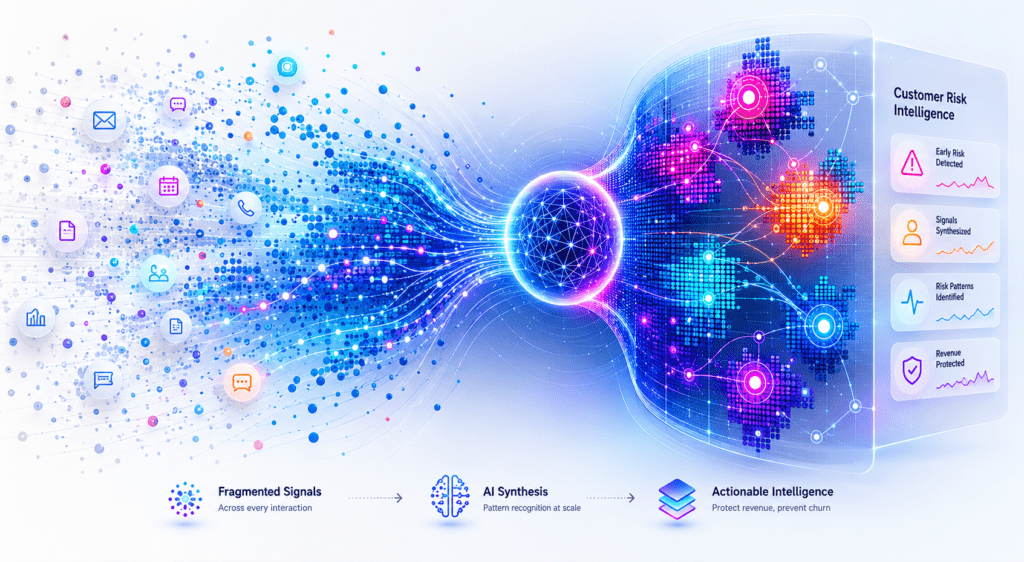
How AI detects Customer Risk Patterns before Revenue is Impacted is by continuously analyzing vast amounts of fragmented customer interaction data—from emails, meetings, support tickets, and product usage—to identify subtle behavioral changes that signal declining health. Unlike traditional metrics that only show revenue decline after it has happened, AI-powered customer intelligence platforms synthesize these scattered signals into coherent, predictive risk patterns. This enables leadership teams to identify emerging issues weeks or months in advance, allowing for proactive intervention that protects portfolio value and prevents unexpected churn.
Customer churn is one of the biggest challenges businesses face, with customer acquisition costs estimated to be five to ten times higher than retention costs. Yet, many organizations struggle to accurately predict and prevent it. Losing customers isn’t just a number on a spreadsheet—it’s a direct hit to revenue, team morale, and long-term growth potential. The stakes are high, and Customer Success teams are at the forefront of addressing this critical issue.
Revenue problems rarely appear without warning. Long before churn shows up in dashboards or forecasts deteriorate, customer interactions already contain signals of dissatisfaction, operational friction, disengagement, and competitive risk hidden inside everyday operational activity.
Why revenue teams discover risk too late
Most organizations operate reactively because their customer intelligence remains scattered across disconnected systems and teams, preventing a unified view of account health. B2B revenue teams lose deals when they cannot see what buyers actually think. This reactive approach stems from scattered engagement data, siloed communication history, and delayed insights that force reps to react to problems instead of preventing them. This operational reality creates significant visibility gaps for leadership.
The late discovery problem
Traditional revenue management relies on lagging indicators that signal problems only after the damage has occurred. This forces CROs and leadership teams to constantly ask questions born from a reactive posture:
-
Timing disconnect: Why is most churn identified so late, creating emergency situations rather than strategic interventions?
-
Forecast instability: Why do revenue forecasts become unstable because risks emerge unexpectedly in quarterly reviews?
-
Reactive firefighting: Why do customer teams spend excessive time reacting to escalations instead of preventing them?
-
Dashboard limitations: Why do our traditional dashboards only show outcomes after damage has already occurred to customer relationships?
Leadership visibility gaps
Traditional methods of identifying churn risks, such as manual reviews of usage data or anecdotal feedback, are often inefficient and too slow to be effective. AI-powered customer intelligence software flips the script by providing predictive insights based on a holistic analysis of vast amounts of customer data. Instead of relying on periodic health scores, AI provides a continuous, real-time assessment of risk across the entire portfolio.
Key takeaway: Revenue outcomes are lagging indicators. The real signals appear much earlier inside customer interactions and operational activity, but most organizations lack the infrastructure to detect and synthesize these patterns into actionable intelligence. For deeper context, see AI Revenue Leakage Detection.
Customer risk starts long before churn
Customer deterioration is not a sudden event but a progressive pattern that unfolds over weeks or months before any visible revenue impact occurs. Understanding this progression is critical because it reveals multiple windows for proactive intervention rather than reactive damage control. The typical timeline from the first warning signs to actual churn can span 30-90 days, depending on contract terms and switching costs, giving prepared teams time to act. This window of opportunity is where AI creates its greatest value—catching problems early enough to fix them.
Risk development timeline
Customer risks emerge gradually through an accumulation of signals that may appear harmless individually but collectively indicate significant relationship deterioration. Key signals include:
-
Unresolved issues: Support tickets that remain open for extended periods or escalate repeatedly without a satisfactory resolution.
-
Declining responsiveness: A noticeable slowdown in email responses, delayed participation in meetings, or a general reduction in communication frequency.
-
Stakeholder disengagement: Key champions or executive sponsors become less involved in meetings, strategic discussions, or planning sessions.
-
Operational friction: The customer experiences implementation delays, persistent integration problems, or workflow disruptions that hinder value realization.
-
Commitment slippage: The customer consistently misses deadlines, delays project milestones, or reduces participation in strategic planning.
-
Adoption barriers: Product usage declines, feature adoption stalls across the user base, or overall user engagement drops significantly.
|
Risk Stage |
Timeline |
Primary Signals |
Intervention Window |
|---|---|---|---|
|
Early Warning |
90-120 days |
Reduced engagement, slower responses |
High success probability |
|
Active Risk |
60-90 days |
Support escalations, stakeholder changes |
Moderate success probability |
|
Critical Risk |
30-60 days |
Competitive evaluation, contract discussions |
Low success probability |
|
Churn Decision |
0-30 days |
Formal termination notice |
Recovery unlikely |
Pattern recognition challenges
If you can identify these signals early, you can step in before customers make the final decision to leave. It is far more effective (and cheaper) to prevent churn than to try winning back a customer after they’re gone. However, individual signals often remain buried inside routine operational activity, making pattern recognition nearly impossible without systematic, AI-driven analysis. Most account managers are juggling too many relationships to spot the subtle shifts that precede departure.
Customer behavior data reveals risk patterns long before a conscious departure decision is made. Understanding healthy versus at-risk patterns enables accurate risk assessment and prioritized intervention.
Key takeaway: The danger is rarely a single interaction. The danger is the accumulation of recurring signals over time that indicate declining value perception and relationship health. This accumulation is exactly what AI is built to detect at scale.
The hidden challenge: Customer Signals are fragmented everywhere
Organizations generate enormous amounts of customer intelligence daily, but this critical information remains trapped in disconnected systems that prevent a comprehensive risk assessment. A customer intelligence platform is software that collects, analyzes, and activates customer data to enable data-driven decisions across your revenue organization. Where your CRM tracks what happened, customer intelligence platforms predict what will happen next by analyzing behavioral patterns and engagement signals across all your disparate systems.
Data fragmentation across systems
Customer intelligence is spread across multiple operational systems, with no single source of truth for relationship health:
-
CRM Systems: Track meetings, opportunities, and formal communications but often miss the crucial sentiment and context behind them.
-
Email Platforms: Contain detailed conversations, negotiations, and feedback but lack systematic analysis for risk indicators.
-
Meeting Transcripts: Hold strategic discussions and direct stakeholder feedback but remain unstructured and difficult to analyze at scale.
-
Support Interactions: Reveal operational frustrations and technical issues but often stay isolated from the commercial context of the relationship.
-
Product Usage Systems: Show adoption patterns and feature engagement but are disconnected from overall relationship health and sentiment.
-
ERP Workflows: Contain payment histories, billing disputes, and procurement changes but lack visibility for customer success teams.
Organizational silos
Historically, forecasting lived in spreadsheets, and most decisions were made by manually stitching together insights from all these siloed systems. That model is starting to break. Not because the tools are bad, but because the complexity of modern B2B buying has outgrown them, creating intelligence gaps between teams. You can’t manage what you can’t see, and right now, most revenue leaders are managing blind.
|
System |
Data Type |
Risk Signals |
Typical Owners |
|---|---|---|---|
|
CRM |
Meetings, opportunities, pipeline |
Deal delays, stakeholder changes |
Sales teams |
|
Support |
Tickets, escalations, resolution time |
Issue frequency, satisfaction scores |
Support teams |
|
Product |
Usage, adoption, feature engagement |
Activity decline, feature abandonment |
Product teams |
|
Finance |
Payments, contracts, renewals |
Payment delays, contract disputes |
Finance teams |
The intelligence synthesis gap
Teams often manage accounts through fragmented updates that lack portfolio-wide context. An account manager may notice a local issue with one customer, but leadership lacks the comprehensive visibility to see systemic patterns affecting multiple accounts simultaneously across the entire business. When you’re drowning in disconnected data, pattern recognition becomes impossible.
Key takeaway: Organizations are overwhelmed by disconnected customer signals, not a lack of data. The problem is synthesizing these fragmented signals into actionable intelligence that enables proactive decision-making across the entire revenue organization. This synthesis challenge is where AI fundamentally changes the game.
How AI changes Customer Risk Detection
AI fundamentally transforms customer risk detection by providing continuous, automated intelligence that operates beyond human analytical capabilities. As one study on the topic notes, an Artificial Intelligence (AI)-driven framework integrated within CRM systems can proactively identify and retain high-risk customers. Unlike traditional periodic reviews, AI enables systematic pattern recognition across entire customer portfolios in real-time, changing the operational model from reactive to proactive.
Continuous intelligence at scale
AI changes the operational model of customer risk detection through several key capabilities that are impossible to achieve at scale with manual effort:
-
Continuous Monitoring: AI can continuously monitor all customer interactions at scale without the constraints of human resources.
-
Subtle Signal Detection: AI algorithms are designed to detect subtle signals—like changes in communication sentiment—that humans often miss across hundreds or thousands of accounts.
-
Pattern Identification: AI identifies recurring behavioral and operational patterns across different accounts that indicate systemic, portfolio-wide risks.
-
Multi-Source Analysis: AI synthesizes both structured and unstructured information from disparate systems (email, CRM, support) in real-time.
-
Predictive Intelligence: AI enables a state of continuous intelligence, replacing the outdated model of periodic reviews or reactive escalation management.
Enhanced detection capabilities
AI can aggregate and analyze data from every touchpoint, such as product usage, email communication, support tickets, and even sentiment in chat conversations. For example, if a customer’s usage decreases sharply while their communication tone shifts toward dissatisfaction, AI can flag this combination as a high-priority risk. Machine learning models also consider broader engagement trends, renewal history, and account tier, providing a nuanced, multi-dimensional picture of each customer’s likelihood to churn.
|
Traditional detection |
AI-powered detection |
Business impact |
|---|---|---|
|
Periodic health scores |
Real-time risk assessment |
Earlier intervention opportunities |
|
Manual account reviews |
Automated pattern recognition |
Complete portfolio coverage |
|
Single-system alerts |
Multi-source synthesis |
Comprehensive risk understanding |
|
Reactive escalations |
Predictive intelligence |
Proactive relationship management |
AI can identify emerging dynamics that traditional systems miss entirely:
-
Rising dissatisfaction: Sentiment analysis reveals negative trends in communications long before formal complaints are filed.
-
Operational friction: AI connects process delays, integration problems, or workflow disruptions that accumulate over time into a clear risk pattern.
-
Engagement decline: The system flags reduced meeting participation, delayed responses, or decreased strategic involvement from key stakeholders.
-
Expansion hesitation: AI detects signals indicating a customer’s reluctance to expand usage, add users, or upgrade plans, which often precedes churn.
Key takeaway: Traditional systems detect account status. AI detects emerging customer dynamics that enable proactive intervention before revenue impact occurs. The difference is measured in months of advance warning.
The Breakthrough: From isolated alerts to Risk Patterns
The fundamental innovation in AI-driven customer intelligence lies in its ability to synthesize isolated signals into coherent, meaningful patterns that reveal systemic risks across an entire customer portfolio. As AI analyzes patterns across your customer base to identify early warning signs, the system learns which combinations of behaviors typically precede churn (like declining usage along with increased support tickets) and flags accounts showing those patterns. This gives you weeks or months to step in and get your customer back on track.
Beyond alert fatigue
Most organizations generate an excessive number of individual alerts that create noise rather than clarity for leadership teams. This “alert fatigue” causes important signals to be missed. Signal Patterns represent a breakthrough approach that transforms disconnected alerts into strategic intelligence.
-
Alert overload: Traditional systems generate too many individual, low-context alerts that overwhelm teams and obscure what’s important.
-
Context disconnect: Individual alerts lack the broader context of portfolio-wide trends, making it impossible to distinguish a one-off issue from a systemic problem.
-
Strategic confusion: Leadership teams need strategic clarity on the biggest risks, not a flood of operational notifications.
-
Resource misallocation: Without understanding pattern severity and revenue impact, teams cannot prioritize their intervention efforts effectively.
Signal Pattern Definition
Signal Patterns are AI-synthesized intelligence that groups related customer signals into recurring portfolio-wide patterns, revealing systemic risks and opportunities. This approach provides several operational advantages by categorizing risks into actionable groups:
|
Pattern category |
Risk indicators |
Revenue impact |
Intervention approach |
|---|---|---|---|
|
Onboarding Friction |
Implementation delays, support escalations |
Early churn, expansion risk |
Process improvement, training acceleration |
|
Support Responsiveness |
Ticket volume, resolution time, satisfaction |
Relationship deterioration |
Support process optimization |
|
Executive Engagement |
Meeting participation, strategic involvement |
Champion loss, renewal risk |
Executive relationship building |
|
Competitive Pressure |
Evaluation activities, vendor meetings |
Immediate churn risk |
Competitive response, value reinforcement |
Pattern-Driven Intelligence
By focusing on patterns instead of isolated alerts, leadership gains strategic clarity. This intelligence provides:
-
Account quantification: Instantly identify how many accounts are affected by each recurring pattern.
-
Revenue exposure: Calculate the total revenue at risk from all accounts affected by a specific pattern.
-
Trend acceleration: Track whether patterns are accelerating, stabilizing, or declining across the portfolio over time.
-
Operational breakdowns: Reveal recurring operational issues (e.g., poor onboarding) that create systematic customer risks.
-
Intervention prioritization: Focus leadership attention on the patterns with the highest revenue impact and the highest probability of successful intervention.
According to research, organizations that implement AI-powered predictive platforms report 60% higher accuracy in identifying 90-day converters compared to traditional manual processes.
Key takeaway: Patterns matter more than isolated signals. AI-powered Signal Patterns enable strategic decision-making by transforming operational noise into portfolio-wide intelligence that protects and expands revenue. Understanding how to detect these patterns is critical to understanding how to manage them. For deeper context, see AI Revenue Intelligence: Technical Implementation Guide.
How AI detects Customer Risk Patterns Step-by-Step
AI-driven customer risk detection operates through a systematic framework that continuously processes customer interactions and synthesizes them into actionable intelligence. For instance, a model using a Random Forest classifier on a public telecom dataset achieved an accuracy of 95.13%, demonstrating the power of this approach. This step-by-step process enables organizations to scale pattern recognition far beyond human capabilities.
Step 1: Scan customer interactions continuously
First, AI creates a unified intelligence layer that continuously monitors customer interactions across all fragmented systems:
-
Email Communication: Analyzes sentiment, response times, and communication frequency patterns to detect changes in engagement.
-
Meeting Transcripts: Processes discussions for stakeholder engagement levels, satisfaction indicators, and strategic alignment.
-
Support Interactions: Monitors ticket volume, escalation patterns, resolution times, and customer satisfaction scores.
-
Operational Systems: Tracks implementation progress, project milestones, and workflow efficiency to spot friction.
-
Product Activity: Measures feature adoption, user engagement trends, and other value realization indicators.
Step 2: Detect individual Customer Signals
Next, portfolio intelligence software uses this data and machine learning to proactively identify individual customers at risk of leaving. These tools analyze a wide range of signals—from purchase history and product usage to support interactions and survey feedback—to detect the specific warning signs that often precede a churn decision.
|
Signal Category |
Detection Methods |
Early Warning Timeline |
Accuracy Indicators |
|---|---|---|---|
|
Issue Signals |
Support ticket analysis, escalation tracking |
60-90 days |
High precision for relationship risk |
|
Engagement Signals |
Meeting participation, email responsiveness |
90-120 days |
Strong predictor of stakeholder health |
|
Usage Signals |
Product adoption, feature engagement |
30-60 days |
Direct correlation with value realization |
|
Sentiment Signals |
Communication tone, feedback analysis |
45-75 days |
Leading indicator of satisfaction |
Step 3: Synthesize recurring patterns
AI then groups related signals from across multiple accounts into meaningful patterns that reveal systemic issues or opportunities. Advanced techniques like SHAP and LIME analysis can attribute churn risk to specific features such as contract type, tenure, and technical support, helping to define these patterns with high precision.
Important pattern outputs include:
-
Impacted accounts: A clear list of specific accounts showing similar risk patterns.
-
Revenue exposure: The total revenue at risk from all pattern-affected accounts.
-
Issue trends: Data showing whether the underlying problems are accelerating or stabilizing across the portfolio.
-
Severity movement: Changes in the intensity of a pattern over time (e.g., moving from “moderate” to “critical”).
-
Strategic implications: Insights into the portfolio-wide operational improvements needed to resolve the root cause.
Step 4: Prioritize Strategic Intervention
Finally, leadership teams can use this pattern-based intelligence to coordinate proactive, data-driven responses:
-
Ownership assignment: Allocate specific patterns to the appropriate teams (e.g., a “Support Responsiveness” pattern to the Head of Support) for resolution.
-
Response coordination: Align account management, product, and support teams around a unified plan for pattern-driven interventions.
-
Progress tracking: Monitor the effectiveness of interventions by tracking pattern resolution and account recovery rates.
-
Proactive intervention: Address systemic issues before they escalate and impact revenue, turning a reactive process into a proactive one.
Key takeaway: AI transforms customer risk detection from reactive account management to proactive portfolio intelligence that enables strategic intervention before revenue erosion occurs. The entire process happens continuously, not in quarterly reviews.
Why traditional Dashboards fail
Traditional reporting systems and dashboards fundamentally limit leadership visibility because they describe historical outcomes rather than the emerging causes of customer risk. A revenue intelligence platform is software that helps sales teams understand deal health, forecast risk, and pipeline movement by combining CRM data with signals from calls, emails, and meetings. Unlike a standard CRM or dashboard, it does not just store or display information; it helps teams interpret what is changing inside deals so managers can inspect pipeline earlier, coach more effectively, and forecast with more confidence.
Dashboard limitations
Traditional dashboards provide historical reporting that fails to enable proactive decision-making for several key reasons:
-
Lagging indicators: They show churn after it occurs rather than predicting risk before it impacts the bottom line.
-
Surface metrics: They display high-level metrics like NPS scores and ticket volumes without revealing the underlying causes of those numbers.
-
Snapshot views: They provide point-in-time data without the trend analysis or pattern recognition needed to see where things are headed.
-
Siloed reporting: They present isolated metrics from different systems without connecting related signals across all customer touchpoints.
Critical Information Gaps
Traditional systems often fail to answer the essential strategic questions that leadership teams need answered to guide the business effectively:
|
Traditional dashboard shows |
Strategic question remains |
AI Intelligence provides |
|---|---|---|
|
Churn rate increased 3% |
Why is risk increasing? |
Specific pattern analysis driving departures |
|
Account health score: Red |
Which accounts are connected? |
Portfolio-wide pattern correlation |
|
Support tickets +20% |
Which issues are systemic? |
Recurring problem identification across accounts |
|
NPS score declining |
What deserves strategic attention? |
Prioritized intervention opportunities |
Reactive vs. Proactive Intelligence
The key difference lies in timing and actionability. Traditional churn analysis tells you why customers left after they’re already gone. Retention forecasting tells you which customers might leave while you still have time to save them. This predictive approach requires capturing signals from every customer interaction—from support tickets to executive business reviews—and transforming them into early warnings about revenue risk.
Dashboards describe outcomes. AI identifies emerging causes that enable strategic intervention before revenue impact occurs.
Organizations need intelligence systems that connect fragmented signals into coherent patterns revealing systemic issues affecting multiple accounts. Platforms like ImpactCraft.ai enable this transformation by providing a Customer Signal Radar that synthesizes customer interactions into Signal Patterns, helping leadership teams move from reactive account management to proactive portfolio control. The business case for this shift is compelling, but only if you understand what’s actually at stake.
Key takeaway: Traditional dashboards provide historical reporting rather than predictive intelligence. AI-powered customer intelligence platforms enable strategic decision-making by revealing emerging patterns before they impact revenue outcomes. Making this transition from dashboard-driven to pattern-driven management is the next evolution in revenue operations.
Business Impact: Why early risk detection matters
AI-driven customer risk detection generates measurable business outcomes that extend far beyond traditional churn prevention. For example, one company implemented a churn prediction system that could analyze over 300 variables, which boosted their gross retention rate by 3 percentage points over 18 months, preserving hundreds of millions in revenue. Early detection enables organizations to protect and expand revenue through proactive and scalable portfolio management.
Quantified Business Outcomes
Organizations implementing AI-driven risk detection report several measurable improvements across the board:
-
Churn reduction: According to industry analyses, AI can prevent up to 71% of churn when combined with strategic human efforts.
-
Revenue predictability: Achieve improved forecasting accuracy through early risk identification and systematic intervention tracking.
-
Expansion protection: Early intervention preserves accounts that would otherwise become unavailable for upsell and cross-sell opportunities.
-
Team productivity: Reduced time spent on reactive firefighting enables teams to focus on strategic relationship building and account development.
-
Portfolio coverage: Scale customer portfolio coverage and monitoring without needing to make proportional headcount increases.
Economic impact analysis
The economic benefits of early risk detection compound across several dimensions. Given that a 5% increase in retention can boost profits by 25–95%, the financial implications are significant:
|
Impact category |
Measurement |
Typical improvement |
Revenueimplications |
|---|---|---|---|
|
Unexpected Churn |
Churn prediction accuracy |
40%+ reduction |
Protected recurring revenue |
|
Forecast Reliability |
Forecast accuracy |
15-25% improvement |
Better strategic planning |
|
Intervention Timing |
Early warning detection |
60-90 days earlier |
Higher save rates |
|
Portfolio Coverage |
Accounts monitored |
2x coverage efficiency |
Scalable growth |
Strategic business benefits
This level of predictive insight transforms how businesses approach financial planning. Advanced tools now integrate churn data directly into budgeting and forecasting, enabling finance teams to respond to real-time retention trends instead of relying on outdated historical data. For example, when a spike in churn risk is detected in a specific customer segment, finance teams can adjust forecasts and scenario models based on these live retention signals. This approach eliminates guesswork, replacing it with probabilities rooted in actual customer behavior and giving companies a more accurate view of their cash flow and financial runway.
Early detection enables several strategic capabilities:
-
Proactive portfolio management: Leadership teams gain visibility into emerging risks across the entire portfolio before they affect financial results.
-
Resource optimization: Focus intervention resources on accounts with the highest success probability and revenue impact.
-
Competitive advantage: Respond to customer issues and sentiment shifts before competitors can exploit relationship gaps.
-
Financial planning: Integrate real-time retention trends directly into budgeting and forecasting processes for greater accuracy.
Key takeaway: Early detection enables proactive portfolio control that protects existing revenue while creating expansion opportunities. Organizations can scale customer coverage without proportional cost increases while improving financial predictability. The ROI compounds rapidly as patterns are identified and systematically addressed. For measured impact data, see 82% of Companies Are Seeing Positive AI ROI.
Which Organizations Benefit Most from AI-Driven Risk Detection
AI-driven customer risk detection provides the greatest value for organizations managing complex customer portfolios where manual pattern recognition is operationally impossible. With the average company managing 305 SaaS applications, data fragmentation is a universal problem. However, organizations with specific characteristics experience disproportionate benefits from implementing systematic customer intelligence platforms.
Industry Segments
Several industry verticals benefit significantly from AI-powered customer intelligence due to their business models:
-
B2B SaaS: Businesses with recurring revenue models where retention and net revenue retention (NRR) directly impact valuation and growth trajectory. Particularly, PE-backed SaaS companies, under pressure to rapidly improve retention metrics and revenue predictability in preparation for an exit can benefit from Customer portfolio intelligence.
-
Industrial Equipment: Companies with complex selling cycles and long implementation periods that require continuous relationship monitoring and health management.
-
Logistics Platforms: Service delivery businesses where operational excellence and proactive customer satisfaction management are key differentiators.
-
Building Materials: Businesses with project-based relationships that require sustained engagement across multiple stakeholders over long timelines.
Organizational Characteristics
Organizations with these shared characteristics experience the maximum value from AI-driven risk detection:
|
Characteristic |
Impact on Risk Detection |
AI Solution Benefits |
|---|---|---|
|
Large Customer Portfolios |
Manual monitoring is impossible to scale. |
Complete, automated portfolio coverage |
|
Fragmented Systems |
Signals are scattered across many platforms. |
Unified intelligence synthesis |
|
Recurring Revenue Dependence |
Retention is the primary driver of business value. |
Proactive retention management |
|
Operational Complexity |
Multiple touchpoints create hidden risk. |
Pattern recognition across all interactions |
|
Expansion-Driven Growth |
Poor relationship health prevents expansion. |
Early intervention preserves growth potential |
Scale Considerations
This technology is most valuable for B2B SaaS companies with $5M+ ARR and a sales team too large for the CRO to inspect every deal manually. The value of AI-driven customer intelligence increases directly with organizational scale and complexity:
-
Customer volume: Organizations managing hundreds or thousands of customer relationships cannot rely on manual pattern recognition.
-
Revenue concentration: Companies with significant revenue concentrated in a few key accounts need systematic monitoring to prevent catastrophic, unexpected losses.
-
Team distribution: Organizations with geographically distributed or siloed customer-facing teams require centralized intelligence to maintain portfolio visibility.
-
Growth pressure: Companies under pressure to scale revenue efficiently must optimize retention before pouring more resources into acquisition.
The larger and more complex the customer portfolio becomes, the harder manual risk detection becomes. AI-powered customer intelligence scales pattern recognition beyond human limitations.
Key takeaway: Organizations with large, complex customer portfolios dependent on recurring revenue experience maximum value from AI-driven risk detection. The larger the portfolio and higher the operational complexity, the greater the benefit from systematic customer intelligence. If you’re managing more than a few hundred accounts, you’re already at the scale where AI becomes essential, not optional.
The Future of Revenue Management
The evolution toward AI-powered customer intelligence represents a fundamental transformation in how revenue organizations operate. Looking ahead, experts predict that by 2026, the most successful startups will be those that act swiftly on real-time insights. Leveraging AI-powered churn prediction alongside intelligent financial planning turns retention into a strategic growth driver—one that protects revenue, sharpens forecasting, and provides the clarity needed to scale with confidence.
Operational transformation
Revenue organizations are transitioning from reactive, siloed workflows to continuous, intelligence-driven operations:
-
Intelligence-first approach: AI is becoming the central intelligence layer that sits above fragmented customer systems, providing unified visibility.
-
Pattern-driven management: Leadership teams are increasingly managing their portfolios through high-level patterns rather than isolated, anecdotal account updates.
-
Continuous optimization: Real-time intelligence enables continuous improvement of processes and strategies rather than relying on periodic adjustments.
-
Predictive operations: Organizations are shifting from a culture of reactive escalation management to one of proactive, data-driven intervention.
Strategic evolution
In a world where growth depends on efficiency, alignment, and predictability, revenue intelligence isn’t just helpful; it’s essential. Future customer management will prioritize several key operational changes that move the entire organization from a reactive to a proactive stance.
|
Traditional approach |
Future intelligence model |
Strategic advantage |
|---|---|---|
|
Quarterly business reviews |
Continuous portfolio monitoring |
Real-time risk identification |
|
Account-by-account management |
Pattern-based portfolio control |
Systematic issue resolution |
|
Reactive escalation response |
Proactive pattern intervention |
Prevention over cure |
|
Siloed team operations |
Unified customer intelligence |
Coordinated response capability |
Technology integration
The future of customer revenue management will integrate several technological capabilities to create a seamless, intelligent ecosystem. This is validated by data showing that companies using AI in marketing report a 42% reduction in customer acquisition cost compared to traditional methods, highlighting the efficiency gains.
-
Predictive intelligence: AI systems that identify both risks and opportunities weeks or months in advance of traditional indicators.
-
Automated orchestration: Workflow systems that automatically trigger the appropriate responses and playbooks based on pattern detection.
-
Unified data platforms: Systems that synthesize all customer signals from all touchpoints into a single, coherent intelligence layer.
-
Strategic dashboards: Executive interfaces that provide pattern-driven, strategic insights rather than just operational metrics.
The future of revenue leadership belongs to organizations that can identify customer risk patterns before revenue outcomes change. AI-powered Customer Portfolio Intelligence enables organizations to regain visibility, control, and predictability across complex customer portfolios.
Platforms like ImpactCraft.ai are enabling this transformation through a Customer Signal Radar and Signal Patterns that help leadership teams move from reactive account management to proactive portfolio intelligence that scales with business growth.
Key takeaway: Future customer revenue management will operate through continuous intelligence rather than periodic reviews. Organizations that adopt pattern-driven portfolio management will gain sustainable competitive advantages in retention, expansion, and revenue predictability. The companies that move fastest on this shift will own their markets. For the latest trends, see 2026 AI Business Predictions.
Conclusion
How AI detects Customer Risk Patterns before Revenue is Impacted represents a fundamental shift from reactive account management to proactive portfolio intelligence. By synthesizing fragmented customer signals into coherent patterns, AI reveals emerging risks weeks or months before traditional metrics show deterioration. This enables strategic intervention while relationships are still recoverable, directly protecting and growing revenue.
-
Predictive Advantage: AI identifies customer risk patterns 60-90 days before revenue impact, providing sufficient intervention windows for relationship recovery and expansion protection.
-
Portfolio Intelligence: Signal Patterns transform disconnected alerts into strategic intelligence that enables leadership teams to prioritize high-impact interventions across hundreds or thousands of accounts.
-
Operational Transformation: Organizations transition from reactive escalation management to proactive portfolio control that scales customer coverage without proportional headcount increases.
-
Revenue Protection: Early risk detection enables a 40%+ reduction in unexpected churn while improving forecast predictability and financial planning accuracy.
-
Strategic Positioning: AI-powered customer intelligence provides competitive advantages in retention, expansion, and revenue predictability that compound over time.
The future belongs to revenue organizations that can identify and act on customer risk patterns before revenue outcomes change. AI-powered Customer Portfolio Intelligence enables this transformation by providing the visibility, control, and predictability required to scale complex customer portfolios efficiently.
FAQ
How does AI detect Customer Risk Patterns before Revenue is Impacted?
AI detects Customer Risk Patterns before Revenue is Impacted by continuously analyzing customer interactions across multiple touchpoints—emails, meetings, support tickets, product usage, and operational systems—to identify subtle behavioral changes that precede churn. AI synthesizes these fragmented signals into coherent patterns that reveal systematic risks affecting multiple accounts, enabling leadership teams to intervene 60-90 days before revenue impact occurs. Unlike traditional dashboards that show outcomes after damage occurs, AI provides predictive intelligence that transforms isolated signals into strategic portfolio-wide intelligence for proactive decision-making.
What are Signal Patterns and how do they differ from traditional alerts?
Signal Patterns are AI-synthesized intelligence that groups related customer signals across accounts into recurring portfolio-wide patterns revealing systemic risks. Unlike traditional alerts that create noise through isolated notifications, Signal Patterns provide strategic clarity by quantifying affected accounts, calculating revenue exposure, showing trend acceleration, and prioritizing intervention opportunities. This approach enables leadership teams to focus on patterns with the highest revenue impact rather than managing hundreds of individual alerts.
Which types of customer signals does AI analyze for risk detection?
AI analyzes multiple categories of customer signals including: issue signals from support ticket analysis and escalation tracking; engagement signals from meeting participation and email responsiveness; usage signals from product adoption and feature engagement; sentiment signals from communication tone analysis; and operational signals from implementation progress and workflow efficiency. These signals often emerge 30-120 days before visible revenue impact, providing sufficient intervention windows.
How accurate is AI-powered customer risk prediction compared to traditional methods?
AI-powered customer risk prediction demonstrates significantly higher accuracy than traditional methods, with studies showing up to 95% accuracy rates and organizations reporting 60% higher accuracy in identifying at-risk accounts. Research indicates AI can help prevent up to 71% of churn when combined with human efforts, compared to reactive traditional methods that typically address risks only after relationship damage has occurred. The continuous learning capabilities of AI systems improve accuracy over time as they process more customer interaction data.
What business outcomes can organizations expect from AI-driven customer risk detection?
Organizations implementing AI-driven customer risk detection typically experience a 40%+ reduction in unexpected churn, a 15-25% improvement in forecast accuracy, a 2x increase in portfolio coverage efficiency, and earlier intervention opportunities with 60-90 days of advance warning. These outcomes translate directly to preserved recurring revenue, improved financial planning accuracy, reduced reactive firefighting, and the ability to scale customer portfolio management without proportional headcount increases.
Which organizations benefit most from AI-powered customer intelligence platforms?
Organizations with large customer portfolios, fragmented systems, recurring revenue dependence, operational complexity, and expansion-driven growth models benefit most from AI-powered customer intelligence. This includes B2B SaaS companies (especially those with $5M+ ARR), PE-backed portfolio companies, industrial equipment providers, and logistics platforms. The value increases significantly for organizations managing hundreds or thousands of customer relationships where manual pattern recognition is operationally impossible.
How does AI-driven risk detection integrate with existing revenue operations systems?
AI-driven risk detection integrates with existing revenue operations by acting as a unified intelligence layer that synthesizes customer signals from CRM, support, product analytics, and communication systems. The AI flows insights into existing workflows, CRM systems, and executive dashboards rather than replacing these operational systems. This approach enhances current revenue operations with predictive intelligence without requiring a major system overhaul.
What is the implementation timeline and ROI for AI-powered customer intelligence platforms?
Implementation of an AI-powered customer intelligence platform typically takes 2-8 weeks. Organizations can expect to see a return on investment (ROI) within 3-6 months, primarily through reduced churn rates and improved net revenue retention. The investment scales with organizational size and complexity. The platform’s early detection capabilities and proactive intervention workflows typically demonstrate a clear ROI through preserved revenue and improved forecast accuracy within the first business quarter.
This analysis is based on industry research, platform capabilities, and outcomes reported by organizations implementing AI-driven customer intelligence systems. Results may vary based on implementation approach, organizational characteristics, and customer portfolio complexity.